
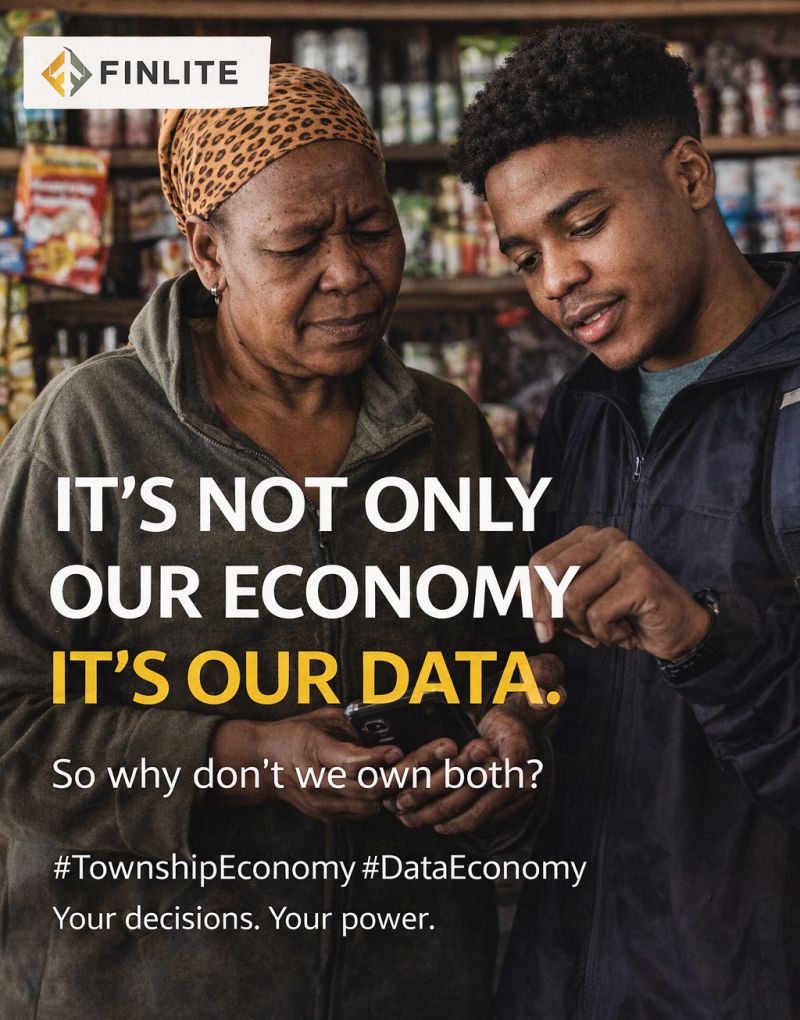
A Massive Economy That Doesn’t Fully Serve Its Creators
The township economy is estimated to be close to R1 trillion in value. It is vibrant, fast-moving, and deeply embedded in everyday life. Yet, much of its true scale only became visible when corporates began analysing transaction data — card payments, mobile transactions, and retail flows.
The same pattern appears in stokvels. For decades, they were seen as small, informal savings groups. Today, we know they circulate over R50 billion annually. That’s not small — that’s a powerful financial system.
And yet, despite this scale, township entrepreneurs and community financial systems remain largely underserved. Why? Because visibility came from outside, not from within.
Capital Follows Data — And Data Is Missing
In every economy, capital moves toward certainty. Investors, banks, and funders rely on:
- Financial records
- Transaction histories
- Growth trends
- Customer insights
Without this data, even the most active and profitable township businesses appear high-risk or invisible. So, while money is moving daily in the township economy, access to funding remains limited. Not because businesses aren’t working — but because their work isn’t being captured, measured, or translated into data.
The Hidden Cost of Operating Without Data
Most township businesses run on experience, instinct, and daily survival decisions. That instinct is powerful — it has sustained the economy for decades. But it has limits.
Without data:
- Pricing is often guesswork
- Customer behaviour is not fully understood
- Stock management is reactive, not strategic
- Growth decisions lack long-term insight
- Opportunities for expansion are missed
The gap is not just about recording what happened yesterday. It’s about using information to predict, plan, and scale.
The Global Proof: Data Unlocks Inclusion
This isn’t a theory — it’s already happening globally.
Countries like India and Kenya have demonstrated how digitisation can transform informal economies:
- Small businesses gain access to microloans through transaction data
- Mobile money platforms create financial histories where none existed
- Informal traders become part of formal financial ecosystems without losing flexibility
The result? More access to credit, faster growth, and broader financial inclusion.
What Happens When Township Entrepreneurs Gain Data Power
If township entrepreneurs had the same ability to collect and use data as larger businesses, the shift would be immediate and significant.
They would gain:
- Better decision-making based on real insights
- Improved access to capital through verified financial activity
- Stronger customer understanding and targeted offerings
- Control over their business growth and direction
- Ownership of the economic narrative they’ve built
This is not about formalising for the sake of compliance. It’s about empowering entrepreneurs with the tools to compete, grow, and lead.
The Role of AI and the Finlite Ecosystem
Artificial intelligence is now changing what’s possible. For the first time, small and informal businesses can:
- Track transactions in real time
- Understand performance without complex systems
- Receive insights in simple, accessible formats
- Make data-driven decisions daily
This is where Finlite is positioning itself at the forefront of transformation. Finlite is not just offering skills training to digitise the township economy. It is building an ecosystem of practical tools designed specifically for:
- Township entrepreneurs
- Stokvels
- Youth-led businesses
- Community-based organisations
The goal is clear: to ensure that the people who built the township economy also own its data, its story, and its future value.
The Real Opportunity
The opportunity in front of us is not to build a new economy. That economy already exists — thriving, adaptive, and powerful.
The real opportunity is to:
- Make it visible
- Make it measurable
- Make it accessible to capital
- And most importantly, make it work for its creators
Because once township entrepreneurs control their data, they don’t just participate in the economy they lead
Author: Andile Fulane, CEO – Finlite: https://www.linkedin.com/in/andile-f-314a2929?utm_source=share_via&utm_content=profile&utm_medium=member_android
#TownshipEconomy #DataEconomy #DigitiseMzansiCampaign