
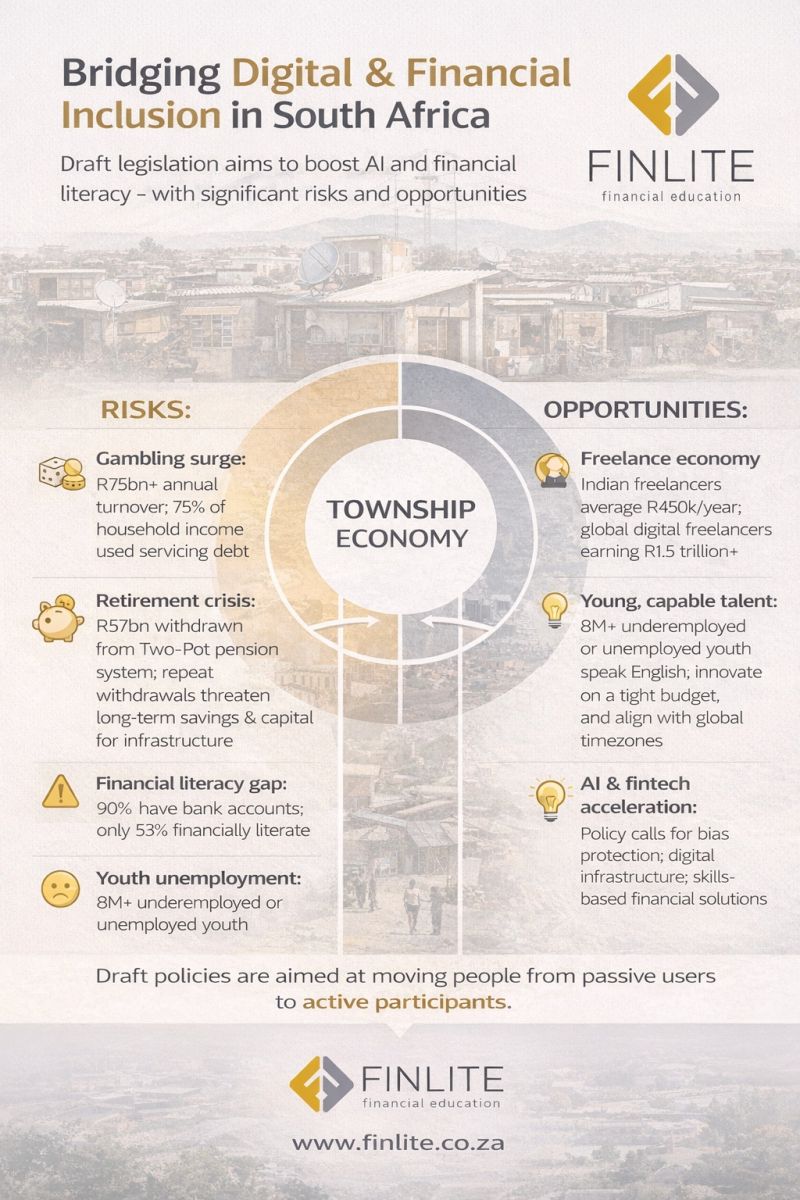
New AI and Financial Education draft policies are trying to move people from access to real capability. Today, around 90% of adults have bank accounts, yet financial literacy remains at roughly 50–55%.
At the same time, the pressure is building:
– Household debt-to-income sits above 60%
– Gambling revenue has exceeded R75 billion annually
– Over R57 billion has already been withdrawn through the Two-Pot retirement system, with repeat withdrawals becoming common
This isn’t just a personal finance issue. It’s quietly eroding long-term national capital. Funds managed by institutions like the Public Investment Corporation, which oversees more than R2 trillion in assets linked largely to the Government Employees Pension Fund, play a critical role in funding infrastructure, listed companies, and broad economic development and participation.
When long-term savings are consistently withdrawn early, it reduces the capital base that drives growth.
Now layer in AI and the global shift to digital work.
Countries like India have built powerful digital export economies. Their IT and digital services sector generates hundreds of billions annually, with freelancers earning significant income, an average of R 450 000 per annum by servicing global markets.
Globally, digital freelance work is massive, but estimates vary. While platforms like Upwork and Fiverr generate billions in activity, broader digital freelance earnings across the global economy are often estimated in the hundreds of billions.
What is clear is the direction:
– Skills are becoming more valuable than degrees
– Work is becoming borderless
– Talent can now be exported without leaving home
South Africa is well positioned: a young population, strong English proficiency (Competitive advantage in the freelance/remote work market), global time zone alignment with Europe.
But again, the same gap appears.
Access without capability does not translate into income.
If we get this right, we don’t just solve unemployment locally.
We position South African youth to participate in the global digital economy.
At Finlite, this is exactly where we play, bridging financial literacy, digital skills, and real economic participation.
The question is: Are we building capability fast enough to match the opportunity?
As agents of economic change in Township and Rural Economies, Finlite will be actively contributing to both AI and Financial Education draft policies.
What will your input be?
hashtag#DigitalInclusion hashtag#FinancialLiteracy hashtag#AI hashtag#TownshipEconomy hashtag#DigitiseMzansiCampaign
Author: Andile Fulane, CEO – Finlite: https://www.linkedin.com/in/andile-f-314a2929?utm_source=share_via&utm_content=profile&utm_medium=member_android