
I’ve been thinking about something lately…
For the longest time, the “bottom of the pyramid” was treated like a problem to solve.
Low income. Low margins. High risk.
That narrative stuck for years. Even I wanted nothing to do with Townships when I got exposed to corporate, mainstream. I was echoing a lot of my colleagues in Investment Banking, saying ‘I only follow the money”.
But some players just didn’t buy into it.
They looked at the same market and saw something completely different. Not charity. Not risk. Not limitation.
They saw movement. They saw volume.
They saw people transacting every single day.
And they built around that.
Capitec Bank didn’t try to be fancy. They stripped banking down to what people actually need and made it accessible, simple, and affordable.
That alone changed the game.
Shoprite Holdings didn’t announce that they were entering fintech. They just quietly turned their stores into places where people could send money, pay bills, buy electricity, and manage their lives.
And now Pepkor is taking it even further.
Not loudly. But with real infrastructure.
What’s interesting is that none of them started with “let’s build a bank”.
They started with being useful.
Be where people already are.
Solve everyday problems.
Earn trust over time.
Then layer. First it’s products. Then it’s payments. Then it’s credit.
Suddenly, you’re sitting on a financial ecosystem. I think that’s the part a lot of people are only waking up to now.
The township and informal economy isn’t emerging. It’s been here. It’s been active. It’s been moving money at scale.
We just didn’t build for it properly.
Now we’re seeing businesses that did, and the results are hard to ignore. Sustained double-digit growth. Millions of customers. Entire networks of informal traders plugged into digital systems.
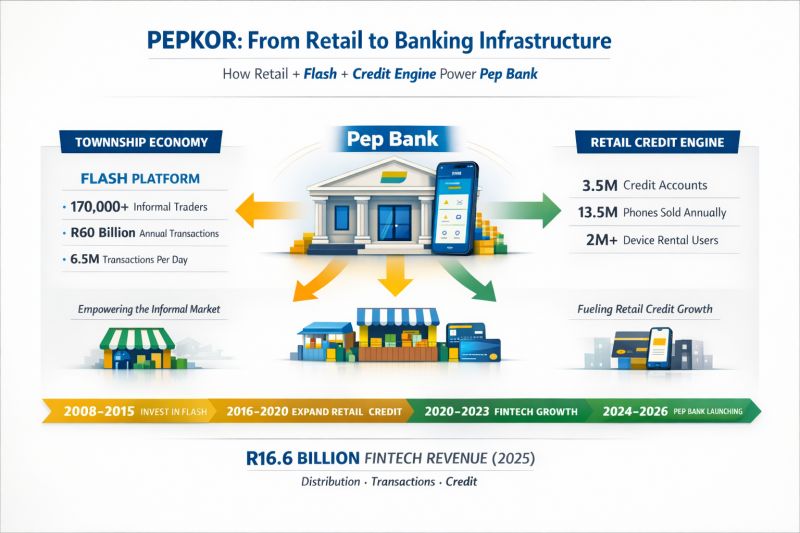
What Pepkor has done with Flash, retail credit, devices… it’s not random.
It’s layered thinking.
You touch the customer through retail.
You enable transactions through platforms. You understand behaviour through data. You extend value through credit.
By the time you introduce banking, you’re not starting from zero. You’re formalising something that already exists.
So maybe the real question isn’t whether there’s opportunity in this market. That part is settled. Maybe the real question is whether this is the way to build in Africa?
Not starting with the product.
Starting with the ecosystem.
Not chasing users.
Embedding yourself in how people already live and transact.
Because once you have that…
You’re not just another service provider.
You become part of the economy itself.
And from there, everything else becomes easier to build.
This is why the township economy matters.
This is why informal trade matters.
This is why digital enablement at that level matters.
It’s not small. It’s not niche.
It’s the foundation.
hashtag#DigitiseMzansiCampaign
hashtag#TownshipEconomy
hashtag#Fintech
hashtag#FinancialInclusion
hashtag#EmergingMarkets
hashtag#FinliteFintechAcademy
Andile Fulane, CEO – Finlite: https://www.linkedin.com/in/andile-f-314a2929?utm_source=share_via&utm_content=profile&utm_medium=member_android