
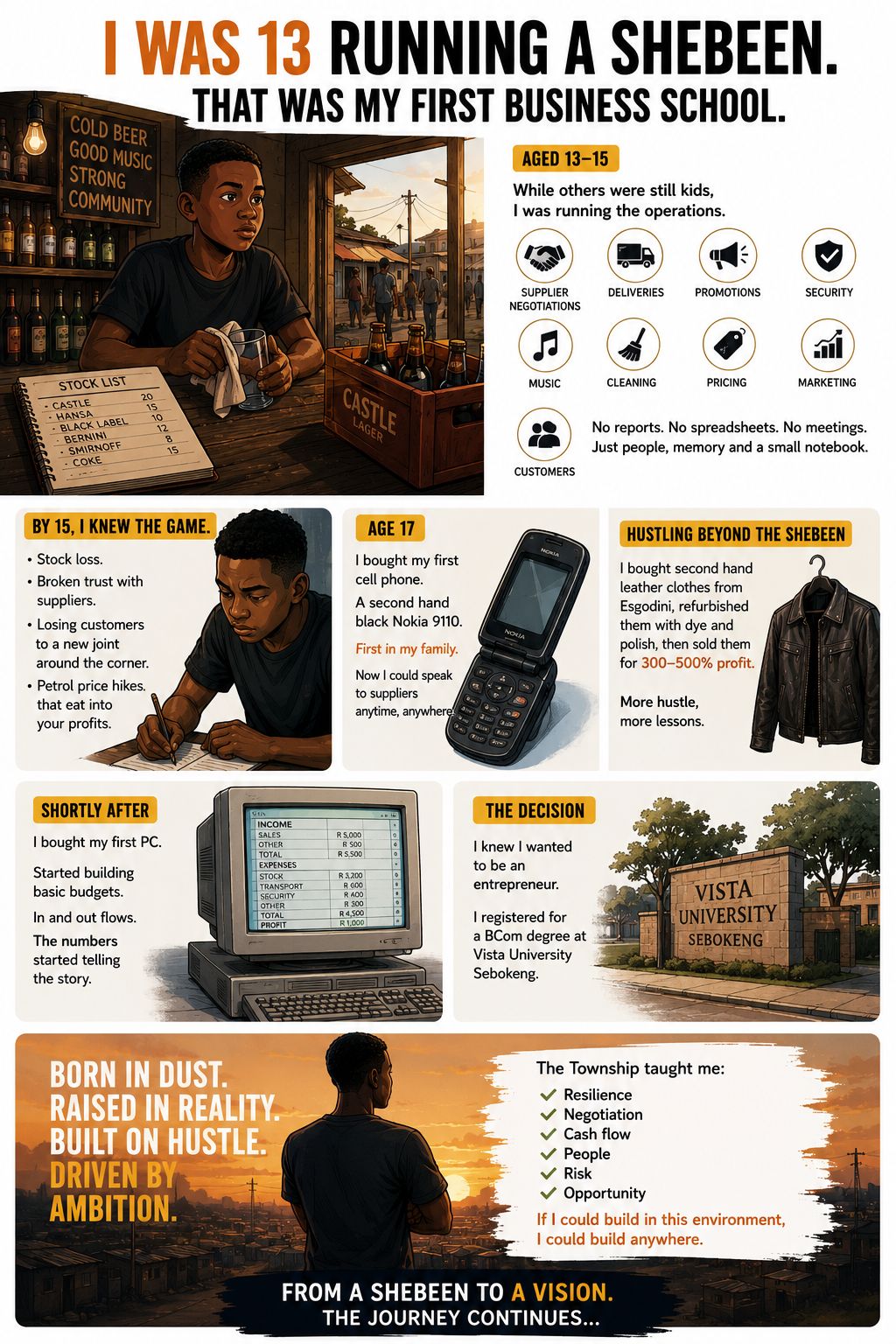
When I was thirteen, I was already running my father’s shebeen. Looking back now, it remains the longest surviving business he ever had. And I think I understand why.It was the only business where he truly involved the family.My father spent a lot of time away working — and, of course, enjoying life too — so I had to step in early. What started as helping out gradually became full operational responsibility.
At thirteen, I was already dealing with:
- Supplier negotiations
- Deliveries
- Promotions
- Security
- Music and entertainment
- Cleaning
- Pricing
- Customer complaints
- Managing drunk and sometimes violent customers
I even had to figure out how petrol price increases affected our operating costs before I fully understood economics.
There were no spreadsheets.
No reports.
No strategy meetings.
Everything lived in conversations, memory, and instinct. The only thing written down was the stock list — until the little notebook disappeared.
Learning Business the Hard Way
By fifteen, I already understood the brutal realities of township business.
I learned:
- How quickly supplier trust can collapse
- How customers disappear the moment a new competitor opens nearby
- How stock loss quietly destroys cash flow
- How one bad weekend can destabilise an entire month
These weren’t theories from a textbook.
They were real lessons with real consequences. The township economy has a way of teaching you fast because mistakes are expensive when margins are thin and survival depends on daily cash flow.
My First Cellphone and the Beginning of Independence
At seventeen, I bought my first cellphone — a second-hand black Nokia mobile phone.
It was the first cellphone in my family.
Even before my father.
That still makes me smile.
My father worked as a sales representative and had something impossible to manufacture: genuine township credibility mixed with sharp communication skills and natural business instinct — despite never matriculating.
At the time, many major retail brands were still hesitant to operate in townships because of political violence and instability. They needed people who understood the environment and could build trust on the ground. My father could walk into almost any township and command immediate respect. Corporate executives valued him because he could do something many couldn’t:
he could walk the talk.
The Hustle Mentality Started Early
While many of my peers still relied on pocket money, I was already hustling. Besides helping run the shebeen, I started buying second-hand leather jackets from hidden spots in Johannesburg — especially places like Esgodini. I restored them using dye and polish, then resold them at margins of 300% to 500%.
That small business taught me:
- Product presentation matters
- Branding matters
- Perceived value matters
- Profit lives in the margin
Once I had my cellphone, everything changed.
Now I could contact suppliers wirelessly, coordinate deals faster, and operate more independently. Soon after, I bought my first PC and started building basic business budgets. It helped that I was studying commerce in high school, but more importantly, I was applying those lessons in real life immediately. That was the turning point. That’s when I knew: I wanted to become an entrepreneur.
From Township Hustle to University
That decision eventually led me to register for a BCom degree at Vista University Sebokeng, which later became part of North-West University. But truthfully, long before university, the township had already educated me.
People often assume that growing up in dusty townships with:
- Broken roads
- Sewage spills
- Neglected infrastructure
…automatically puts you behind. But for some of us, that environment became the greatest business school imaginable.
The Township Teaches What Textbooks Cannot
That environment taught me:
- Resilience
- Negotiation
- Cash flow management
- Consumer behaviour
- Risk management
- Community economics
- Survival
Most importantly, it taught me adaptability.
Because when you build in environments with limited resources, uncertainty, and constant pressure, you develop a level of business instinct that cannot easily be taught. And somewhere along the journey, I became convinced of something powerful:
If we can build businesses here, we can build businesses anywhere.
Why the Township Economy Matters to Me
This is why I remain deeply passionate about the township economy.
Not from a distance.
Not academically.
Not theoretically.
Its risks are real to me.
Its opportunities are real to me.
Its resilience is real to me.
I’ve lived both the struggle and the potential.
And I believe the future of South Africa’s economic growth will not only come from corporate boardrooms or formal markets.
It will also come from the entrepreneurs being shaped every day in townships — learning business the hard way, just like many of us did
Andile Fulane, CEO – Finlite: https://www.linkedin.com/in/andile-f-314a2929?utm_source=share_via&utm_content=profile&utm_medium=member_android
#TownshipEconomy #Entrepreneurship #FinancialLiteracy #YouthDevelopment #DigitalInclusion #InformalEconomy #DigitiseMzansiCampaign